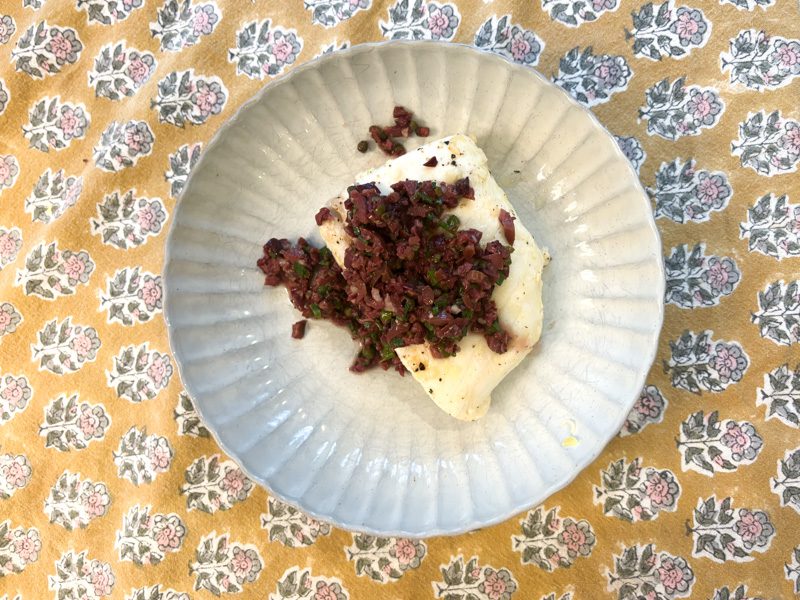
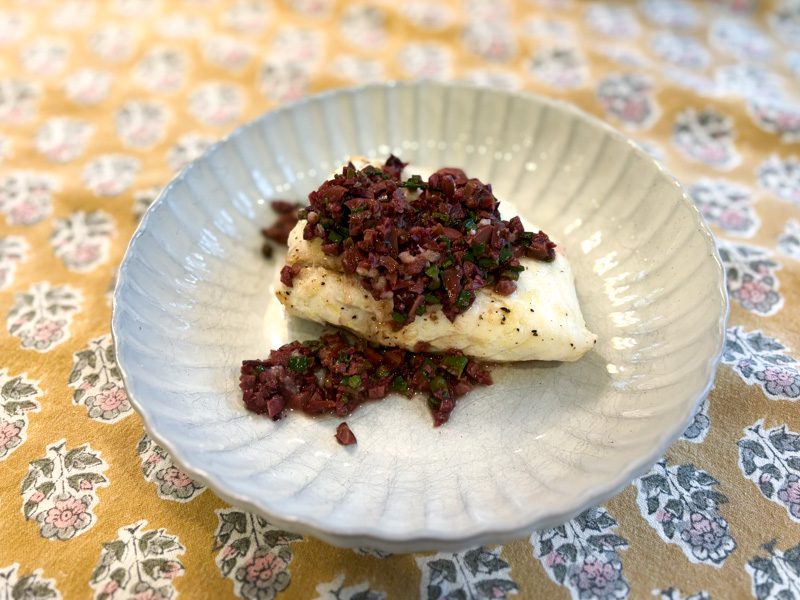
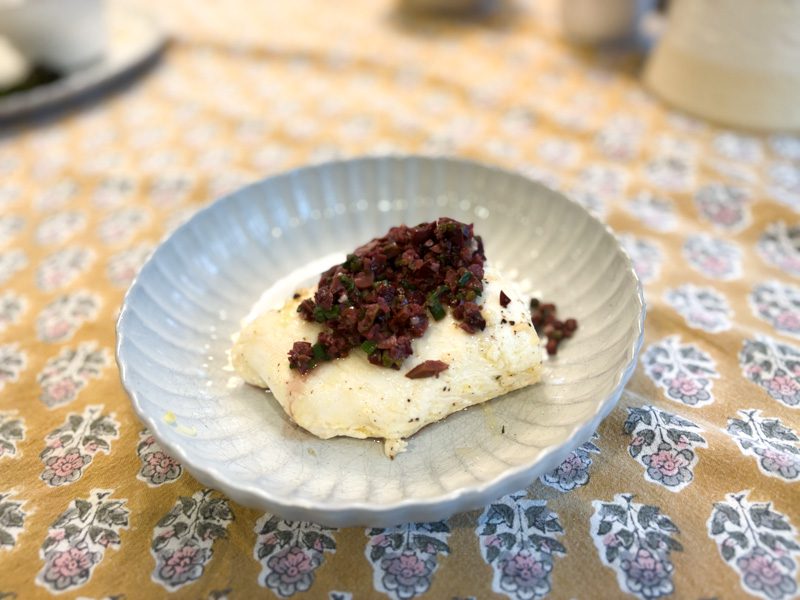
Halibut with lemon and olive tapenade is one of my go-to quick-but-light warm weather dinners. Fresh halibut is marinated in lemon, garlic, and olive oil, baked, then topped with cool olives in a fresh lemon, garlic, chive sauce.
Summer Dinners
Like many people, I start craving “light” foods as soon as the weather starts hinting that it’s about to get oppressively hot. Cold cucumbers (so unappealing in winter – so irresistible in summer), fresh, uncooked tomatoes, herbs, cold capers, cold olives, etc.
When it comes to dinner proteins, white fish is near the top of that list. It has the benefit of being quick to cook. And over the years I’ve started serving it with cold and tangy olive tapenade.
The one caveat is that this is a good early summer dish. Because you do need an oven, which might not be ideal on days where the heat gets over 85F. I suppose you could try this on the grill – I will be trying that out later this summer. But I haven’t yet experimented with that option. Will provide notes once I’ve dug into this. For now, I recommend sticking with the oven.
The Importance of Good Halibut
This dish highlights the delicate flavor of halibut – mild, slightly sweet, and briny. This means you need good halibut for the recipe. In other words, when you prep the fish – you should notice no smell. This is not a good recipe for when you have a fillet that is a bit past its prime but still edible.
If you do notice a smell when you start to prepare the dish, I would suggest pivoting toward a recipe that has more of a sauce, where the flavor of the fish is a complement, but not the star of the show. For instance, this white fish baked with tomatoes, olives, and capers is a great option. It’s a quick, very tasty, and summery dish.
Frozen Fishes
In trying to minimize the risk of past-prime halibut, I’ve had the best luck with frozen halibut. There are lots of good options online these days that have great halibut. I move my fillets from the freezer to the refrigerator the night before so it’s ready to go by dinner. This is the most reliable option, because I know I have very fresh fish available pretty much whenever I want. Provided I remember to move the fish to the fridge the evening before, of course.
FYI – The evening-before freezer-to-fridge move is by far the best way to defrost fish. I do not recommend trying to speed up the process by soaking it in cool water (the other, fast, method to defrost fish). While I have had this work out without issues, I have also had it spectacularly not work out, and it’s never a pleasant discovery. For this recipe in particular, where you really want to maximize freshness, I wouldn’t take the gamble.
Grocery Store Fish
I’ve also had decent luck with halibut at our local grocery store, but it is more hit or miss. Sometimes they don’t have it, sometimes it doesn’t look great.
To find good fish, you’re at a disadvantage already when you’re buying a fillet. The best way to judge freshness is to see the whole fish. For a whole fish, lots of people check the eyes – but fish stored in ice can have cloudy eyes, even if the fish is otherwise fresh. Also, the eyes vary between species and based on how the fish is handled. The two most important things I would check are the gills (which should be bright red or pink, not brown, gray, or sticky/slimy), and the smell (you want the fish to smell like the ocean, not fishy).
For fillets, you’re looking for translucency, vibrancy of color (bright white for halibut), a moist appearance (but not sliminess), and a tight, firm texture (i.e., no flaking or separation into segments). The edges should not look discolored or dry. The best method here is to ask if you can smell the fish – this is always a pretty solid indicator of whether or not something is fresh.
Halibut with Lemon and Olives
This dish started out with a Lemon-Marinated Halibut recipe from Serious Eats. My husband and I started making this back before we had kids and loved it. Since then we’ve tweaked the recipe a bit.
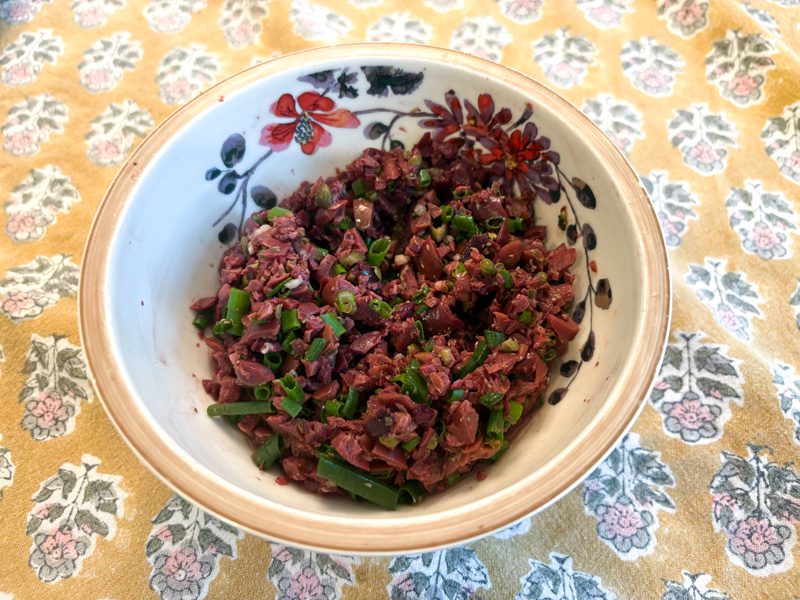
Most importantly, I always felt like something was missing until I started chopping up olives, garlic, and herbs and eating them alongside the halibut. Maybe because the fish is so light, it needed a punchy but fresh flavor alongside. Whatever it is, the brine of the olives and capers and the more subtle brine of the halibut work really well together. When it’s a really fresh halibut, I feel like I’m standing by the harbor, eating something straight out of the ocean.
Note for Moms, Moms-to-be, and Kids
Halibut is one of those fish that the FDA considers a “good choice” fish, not a “best choice.” This is because, as a larger fish species, it tends to accumulate more mercury. That means you shouldn’t serve it to young kids, or eat it yourself if you’re pregnant or breastfeeding, more than once a week, no matter how delicious it is.
What does once a week look like?
The FDA guidelines explain that for pregnant women, this means a single 4-ounce serving (think the palm of your hand), once a week.
For kids ages 1-3, a 1-ounce serving, once a week.
For kids ages 4-7, a 2-ounce serving, once a week.
For kids 8-10, a 3-ounce serving, once a week.
For kids 11+, a 4-ounce serving, once a week.
Olive Tapenade
I like the olive tapenade on this fish tastes best without capers. It’s less complex and therefore more punchy. Because I make it without capers, it technically is not tapenade. But I still think tapenade is the best descriptor here, so I’m sticking with it. So now I’ve said it, and now we can move on.
Also – my kids have an off-and-on-again relationship with olives. So I let them eat the fist topped with olive oil and a bit of salt if they prefer. Maybe a squeeze of lemon. It’s truly very delicious that way.
Now, on to the recipe.
Print
Halibut with Lemon and Olive Tapenade
Halibut with lemon and olive tapenade is one of my go-to quick but light warm weather dinners. Sweet but briny halibut is topped with chopped olives in a tangy fresh lemon, garlic, chive sauce.
This goes great with fresh bread or rice cooked in chicken broth.
Ingredients
For the Fish
1 lb halibut (cut into 2 fillets; fresh or defrosted)
1 tbsp crushed or minced garlic (from 2–3 cloves of garlic)
4 tbsp lemon juice
3 tbsp olive oil
1/2 tsp salt
couple grinds freshly ground pepper
For the Tapenade
1 1/2 cups kalamata olives
3 cloves of garlic, crushed
3 tbsp lemon juice
2 tbsp olive oil
3 tbsp cilantro, parsley, and/or chives (any alone or mix will do)
Instructions
1. Preheat the oven to 400F.
2. Marinade the halibut for at least 15 minutes.
In a large Ziplock back, mix:
- 1 tbsp crushed or minced garlic (from 2-3 cloves of garlic)
- 4 tbsp lemon juice
- 3 tbsp olive oil
- 1/2 tsp salt
- couple grinds freshly ground pepper
Before adding the halibut, I recommend cutting off the skin. It’s annoying, but it ensures the marinade gets through to as much fish as possible. That said, you could just leave the skin on the fish and not eat it (the way we are cooking the fish – skin down – will not make the skin tasty.
To do this (and minimize grossness), I get 1 rubber glove and put it on my left (non-dominant) hand. I prepare a cutting board by placing several paper towels on top. Put it near the sink. Get a couple extra paper towels and place them within easy reach of the cutting board. Get a paring knife. Take a deep breath. Better times are ahead. Now let’s do this.
Remove the halibut from its packaging with the gloved hand. Rinse it off under cold water. Then place it onto your padded cutting board. Use the extra paper towels to pat it dry. Grab your knife in your non-gloved (dominant) hand. If the 1 lb of halibut is not already cut into 2 fillets, do this first. It will make removing the skin a bit easier.
Then, turn the halibut on its side and use your gloved hand to pull the skin away from the flesh, and your non-gloved hand to cut away the skin, staying as close to the skin as possible.
Once you’re finished, toss the skin (or fry it up for your dogs/cats and make the kitchen very pungent). Put the halibut into the bag, throw out your glove, and seal it up. Let it marinade for at least 15 minutes – ideally closer to 30-40 minutes.
3. Prepare the olive tapenade.
While the halibut marinades, you can prep your olive tapenade – or you can do this while the fish is roasting.
Combine well in a small bowl:
- 1 1/2 cups kalamata olives, chopped finely;
- 3 cloves of garlic, crushed;
- 3 tbsp lemon juice;
- 2 tbsp olive oil; and
- 3 tbsp cilantro, parsley, and/or chives (any alone or mix will do).
4. Roast the halibut in a glass or ceramic pan at 400F.
Take the halibut fillets out of the Ziplock back and place them (ex-skin-side down) in a glass or ceramic baking dish.
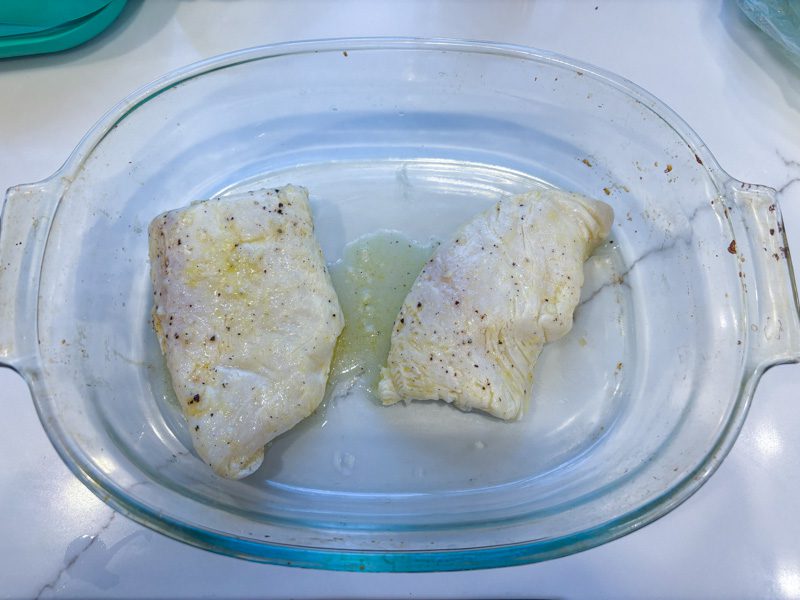
Roast in the oven until the thickets part of the fish reaches 125F. This should take about 15-20 minutes, depending on how thick the fillet is. Good rule of thumb is about 10 minutes per inch of thickness.
Let it sit for about 5 minutes before eating so that the internal temperature comes up a tad before you eat.
5. Enjoy!
After they rest for 5 minutes, they’re ready to eat. Top with the olive tapenade and enjoy.